Best Price Matched. Best Quality Delivered.
Independent lab testing, published in full.
We send our powder to SGS, one of the world’s largest independent testing companies. In January 2026:
Heavy metals — all 19 elements tested under EN 71-3 came back not detected, including lead, cadmium, mercury, arsenic, and chromium.
Lead — not detected. Passes the ASTM F963-23 limit of 100 ppm and REACH limits.
Phthalates — not detected, including all eight restricted under the CPSIA.
Flammability — passed EN 71-2 toy flammability testing. The powder did not ignite under test conditions.
A separate acute oral toxicity study places it in GHS Category 5 (Unclassified) — the lowest hazard band — with an LD50 above 5,000 mg/kg.
It’s a fine powder, so it belongs outdoors. Avoid direct contact with eyes — rinse with water if it happens. Don’t use it in enclosed spaces or near open flame; the same is true of flour. It washes off skin and out of most fabrics with soap and water, though color can temporarily persist on bleached or light-colored hair and on porous surfaces. Wear white or old clothing.
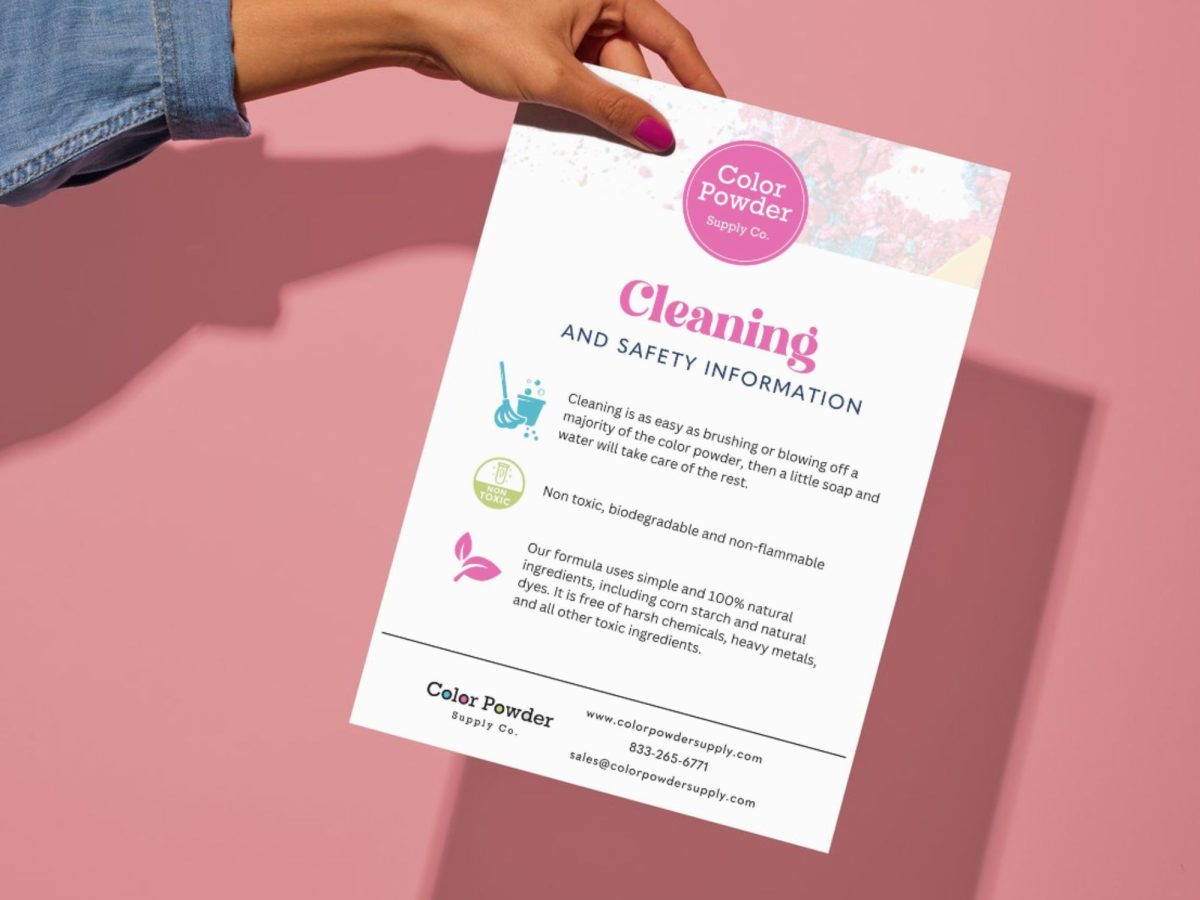
Our powder is 98% food-grade corn starch and 2% FDA-certified color additives. It’s been independently tested by SGS for heavy metals, lead, and phthalates — all not detected — and an acute oral toxicity study places it in GHS Category 5 (Unclassified), the lowest hazard band. It’s made for outdoor use and isn’t intended for consumption.
It isn’t intended for consumption. If someone swallows a small amount, have them drink water. The acute oral toxicity study places the powder in the lowest hazard band, with an LD50 above 5,000 mg/kg. If you have concerns, contact a physician or poison control.
Avoid direct contact with eyes. If it happens, rinse with water. We recommend sunglasses for participants — providing them at your event is an easy way to cut down on eye contact.
It’s a fine powder, so avoid inhaling it and don’t use it in enclosed spaces. Dust masks, bandanas, or gaiters help. Anyone with asthma or respiratory sensitivity should take the same precautions they would around any other fine dust.
It’s been tested for all 14 major food allergens — thirteen absent, gluten below 5 ppm. One thing worth flagging: four of our shades contain FD&C Yellow No. 5 (tartrazine), the colorant most associated with sensitivity reactions in a small number of people. If that matters for your event, contact us and we’ll tell you which shades to avoid.
Our powder is made for outdoor use. Avoid inhaling it, and don’t use it in enclosed spaces. Dust masks, bandanas, or gaiters help at larger events. Anyone with asthma or respiratory sensitivity should take the same precautions they would around any other fine dust. Like all fine powders — including flour and cornstarch — keep it away from open flame.
Planning an event and need to clear it with a school nurse or risk manager? We’ll send a free sample along with our full lab reports.